
Implant-Based Breast Reconstruction in Gurgaon


Implant-Based Breast Reconstruction is a surgical procedure used to recreate the shape and volume of the breast using a breast implant, usually after mastectomy for breast cancer. In selected patients, reconstruction can be performed during the same operation as mastectomy.
The procedure can also be planned as a staged reconstruction, where a temporary tissue expander is used before the final implant is placed.
The choice between implant-based and tissue-based reconstruction depends on factors such as the type of mastectomy, breast size and shape, skin quality, previous or planned radiotherapy, overall health and individual preferences.
Dr. Mansi Chowhan is an Oncoplastic Breast Surgeon in Gurgaon with specialised training in breast oncoplasty and breast reconstruction planning.
What Is Implant-Based Breast Reconstruction?
Implant-based breast reconstruction uses a silicone breast implant to recreate the breast mound after breast tissue has been removed.
It may be performed:
- Immediately after mastectomy
- In a staged approach using a tissue expander
- After a previous mastectomy
- Along with selected nipple-sparing or skin-sparing mastectomy procedures
The reconstruction is planned according to the patient's anatomy and the cancer treatment plan.

Who May Be Suitable for Implant-Based Reconstruction?
Implant reconstruction may be considered for women who:
- Are undergoing or have undergone mastectomy
- Have suitable breast skin and soft tissue
- Prefer an implant-based option
- Do not have factors that significantly increase reconstructive complications
- Understand the potential benefits and limitations of implants
Patients who have had or are expected to have radiotherapy require particularly careful planning because radiation can affect the skin and reconstructed breast.
Types of Implant-Based Reconstruction
There are two commonly used approaches.
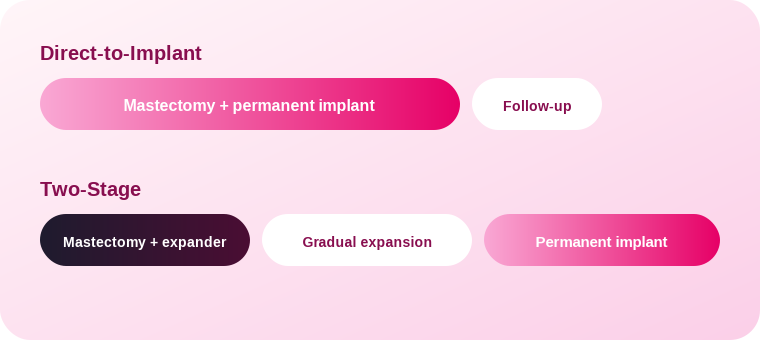
Direct-to-Implant Reconstruction
In selected patients, the permanent breast implant can be placed during the same operation as the mastectomy.
This may be possible when there is sufficient healthy skin and tissue to safely support the implant.
Two-Stage Reconstruction
A tissue expander is initially placed during the mastectomy.
Over subsequent appointments, the expander is gradually filled to stretch the skin and create an appropriate breast pocket.
It is later replaced with a permanent implant.
This approach provides greater flexibility when additional tissue expansion is required.
How Is Implant-Based Breast Reconstruction Performed?
1. Preoperative Planning
The surgeon evaluates breast size, shape, skin quality, nipple position and the planned mastectomy technique.
Previous surgeries, medical conditions and any planned cancer treatments are also considered.
2. Mastectomy
The breast tissue is removed by the breast cancer surgeon.
Depending on the patient's condition, a skin-sparing or nipple-sparing approach may be possible.
3. Implant or Tissue Expander Placement
A permanent implant or temporary tissue expander is placed in the planned position.
The exact technique depends on the patient's anatomy and the available soft-tissue coverage.
4. Breast Shape and Symmetry
The reconstructed breast is positioned to achieve an appropriate shape and balance with the opposite breast.
Additional procedures may sometimes be considered to improve symmetry.
5. Recovery and Follow-Up
The patient is monitored during recovery and receives instructions regarding wound care, activity and follow-up appointments.
Implant-Based Reconstruction After Mastectomy
Implant reconstruction is commonly considered after mastectomy because the procedure removes most of the breast tissue.
Depending on the cancer and anatomy, reconstruction may be performed at the same time as:
- Total mastectomy
- Skin-sparing mastectomy
- Nipple-sparing mastectomy
- Risk-reducing mastectomy
The reconstructive plan should be developed alongside the cancer surgery rather than considered separately.
Implant-Based Reconstruction After Nipple-Sparing Mastectomy
Nipple-sparing mastectomy preserves the nipple and areola while removing the underlying breast tissue.
In suitable patients, an implant can be placed during the same operation.
This can allow the preserved nipple-areola complex to form part of the reconstructed breast.
However, preserving the nipple does not mean that every patient is suitable for immediate implant reconstruction. Blood supply, skin quality, breast anatomy and cancer treatment requirements must be assessed.
Direct-to-Implant vs Tissue Expander
| Feature | Direct-to-Implant | Tissue Expander |
|---|---|---|
| Permanent implant | Placed during initial surgery | Placed during later stage |
| Number of major procedures | May require fewer stages | Usually staged |
| Tissue expansion | Not required | Gradual expansion |
| Suitable for | Selected patients | Wider range of reconstructive situations |
| Planning flexibility | More limited | More flexibility for skin and breast size |
The choice is made according to the individual patient's anatomy and treatment plan.
Benefits of Implant-Based Breast Reconstruction
Potential benefits include:
- Reconstruction without taking tissue from another part of the body
- No donor-site scar associated with flap surgery
- Ability to perform immediate reconstruction in selected patients
- Predictable implant volume
- Potentially shorter surgery compared with some tissue-based procedures
- Possibility of preserving the breast skin envelope with suitable mastectomy techniques
However, implants also have specific limitations and long-term considerations.
Implant-Based vs Autologous Breast Reconstruction
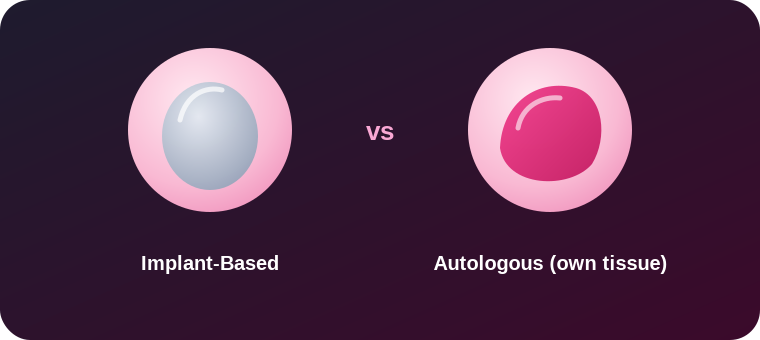
Implant-based reconstruction uses a breast implant, while autologous reconstruction uses the patient's own tissue, such as tissue from the abdomen or another donor site.
Implant-based reconstruction may avoid a donor-site operation,
whereas autologous reconstruction can provide a breast made from the patient's own tissue.
Factors such as radiotherapy, body shape, previous surgery, medical history and personal preferences can influence which option is considered.
There is no single reconstruction method that is appropriate for every patient.
How Does Radiotherapy Affect Implant Reconstruction?
Radiotherapy can affect the skin and tissues surrounding a breast implant.
It may increase the risk of complications such as:
- Capsular contracture
- Skin changes
- Implant-related complications
- Changes in breast shape
- Wound-healing problems
If radiotherapy is expected, reconstruction may require a different strategy or timing.
The breast cancer and reconstruction teams should consider planned cancer treatment before finalising the surgical approach.
Recovery After Implant-Based Breast Reconstruction
Recovery varies according to whether reconstruction is performed alone or together with mastectomy and lymph node surgery.
Patients may experience:
- Chest or breast discomfort
- Swelling
- Bruising
- Tightness
- Temporary changes in sensation
- Limited arm movement during the early recovery period
Drains may be required temporarily.
Most patients gradually return to normal daily activities, but the timeline depends on the extent of surgery and individual healing.
Risks and Complications
Implant-based breast reconstruction has potential risks, including:
- Infection
- Bleeding
- Seroma
- Wound-healing problems
- Implant exposure
- Changes in breast sensation
- Breast asymmetry
- Implant displacement
- Implant rupture or leakage
- Capsular contracture
- Need for revision surgery
The risk of complications may be higher in certain patients, including those receiving radiotherapy.
How Long Do Breast Implants Last?
Breast implants are not considered lifetime devices.
Some implants may remain in place for many years without problems, while others may eventually require replacement or revision because of complications, changes in the breast or personal preferences.
Regular clinical follow-up is important.
Will the Reconstructed Breast Feel Natural?
The appearance and feel of an implant-reconstructed breast can vary.
Factors include:
- Implant type and size
- Amount of tissue covering the implant
- Mastectomy technique
- Breast size
- Skin quality
- Previous or planned radiotherapy
The reconstructed breast may not feel exactly like a natural breast, and sensation can be reduced following mastectomy.
Can Implant Reconstruction Be Combined With Nipple Reconstruction?
If the nipple cannot be preserved during mastectomy, nipple reconstruction or nipple-areola tattooing may be considered later as part of the overall reconstructive process.
For patients undergoing nipple-sparing mastectomy, the existing nipple-areola complex may be preserved when medically appropriate.
Can Implant Reconstruction Be Done Immediately After Mastectomy?
Yes. Immediate implant-based breast reconstruction can be performed during the same operation as mastectomy in appropriately selected patients.
Immediate reconstruction is not suitable for everyone. The cancer treatment plan, skin condition, blood supply and overall health must be evaluated before surgery.

Implant-Based Breast Reconstruction in Gurgaon
Implant-Based Breast Reconstruction in Gurgaon requires coordination between breast cancer surgery and reconstructive planning.
Dr. Mansi Chowhan is an Oncoplastic Breast Surgeon in Gurgaon with advanced training in breast surgery and oncoplastic techniques, including MCh Breast Oncoplasty (UK) and fellowship training in breast surgery in Paris and at Memorial Sloan Kettering Cancer Center, New York.
The reconstruction plan is personalised according to the type of mastectomy, breast anatomy, cancer treatment and the patient's goals.
Implant-Based Breast Reconstruction Cost in Gurgaon
The cost of implant-based breast reconstruction varies depending on the surgical approach and whether it is performed as part of a larger breast cancer operation.
Factors may include:
- Surgeon and anaesthesia charges
- Hospitalisation
- Mastectomy procedure
- Type and size of implant
- Tissue expander, if required
- Additional reconstructive procedures
- Pathology and investigations
- Follow-up and revision procedures
A personalised estimate can be provided after consultation and treatment planning.
Frequently Asked Questions
What is implant-based breast reconstruction?
It is a reconstructive procedure that uses a breast implant to recreate breast shape after mastectomy or selected breast surgeries.
Can reconstruction be done at the same time as mastectomy?
Yes. Immediate reconstruction may be possible in selected patients.
What is a tissue expander?
A tissue expander is a temporary device used to gradually stretch the breast skin and create space for a permanent implant.
Is direct-to-implant reconstruction possible after nipple-sparing mastectomy?
Yes, it may be possible in appropriately selected patients with suitable anatomy, skin quality and blood supply.
Is implant reconstruction better than flap reconstruction?
Both have different benefits, limitations and risks. The appropriate option depends on factors such as radiotherapy, anatomy, previous surgery, health and personal preference.
Can radiotherapy be given after implant reconstruction?
Radiotherapy may be required after reconstruction depending on the cancer diagnosis. However, it can affect reconstructed tissue and increase certain complications, so this should be considered before surgery.
Will an implant-reconstructed breast have normal sensation?
Sensation is often altered after mastectomy and reconstruction. Some patients experience reduced or changed sensation.
Do breast implants need to be replaced?
Not necessarily at a fixed interval. Implants are not lifetime devices, and replacement or revision may eventually be required if complications or other concerns develop.
How long does recovery take?
Recovery varies from patient to patient and depends on the extent of mastectomy, reconstruction and any additional procedures.
Is implant-based reconstruction possible after previous mastectomy?
Yes. Delayed implant-based reconstruction may be an option for selected patients depending on the condition of the skin and surrounding tissues.